

A bright orb can draw your eye before you notice anything else in a photo. Its brightness might come from a strong light, a reflection, flash hitting a nearby particle or the camera’s exposure. Start with the brightest part of the original image. If the light has a spiritual association for you, its apparent intensity does not tell you how strong that meaning is.
Look for missing detail in the brightest part
If the center is a featureless white patch, the camera may have recorded that area at its upper limit. Photographers call this highlight clipping. Reducing brightness on an exported copy can make the patch greyer, but it can only show detail the file retained. Compare a neighboring original that was exposed differently if you have one.
Flash can also light small particles near the camera, as Sony’s flash photography guidance describes. A strong light outside the frame may produce flare even with flash turned off.
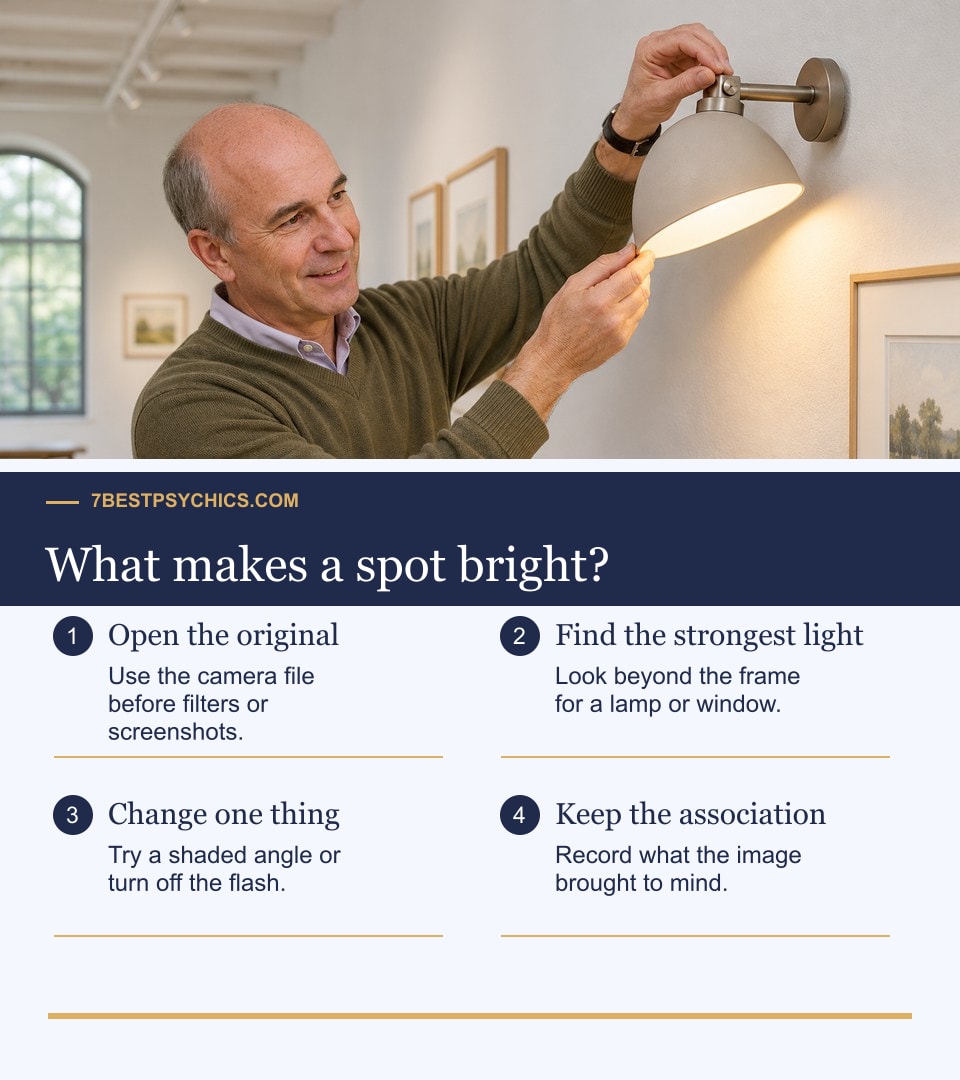
Read the visual guide as text
- Open the original. Use the camera file before filters or screenshots.
- Find the strongest light. Look beyond the frame for a lamp or window.
- Change one thing. Try a shaded angle or turn off the flash.
- Keep the association. Record what the image brought to mind.
A worked example with an entryway light
Imagine a white disk covering part of a coat in a dim entryway photo. The middle is white from edge to edge. The following photo shows a smaller pale dot with some texture. You remember the wall lamp was just beyond the upper corner. From a safe spot, take a new frame with that lamp shaded from the lens and compare it with a frame from the same position with the lamp unshaded.
If the disk changes while the coat remains put, light entering the lens is worth checking. If the setup can’t be repeated, record what you know and leave the cause open.

When brightness feels spiritually important
Light may suggest hope or comfort in someone’s faith, memories or personal practice. Ask what the picture brought to mind on that particular day. A bright spot near a gift someone made you might bring a real memory into focus. A softer spot can carry the same association.
If you see sudden new flashes with your eyes rather than finding a spot in a photo, especially with many new floaters or a shadow like a curtain, seek urgent eye care. The National Eye Institute’s retinal detachment guide explains the urgent warning signs.
Frequently asked questions
1. Why is the center of my orb pure white?
The highlight may have reached the limit of what the camera recorded. Check the original and any neighboring frame with a different exposure.
2. Can a bright orb happen with flash off?
Yes. Light from a lamp, window or the sun can make internal reflections or bright spots without flash.
3. Does a brighter orb have more spiritual energy?
Brightness in a photograph depends on lighting, exposure and processing. It cannot tell you the amount of spiritual energy in a scene.
4. What is a quick comparison I can make?
With the subject still, try the same framing before and after shielding the lens from an off-frame light. Compare the position and detail of the spot.
5. What if I see flashes even when I’m away from the camera?
Sudden new flashes, many new floaters or a dark curtain in your vision warrant urgent eye care.