Jump to a section
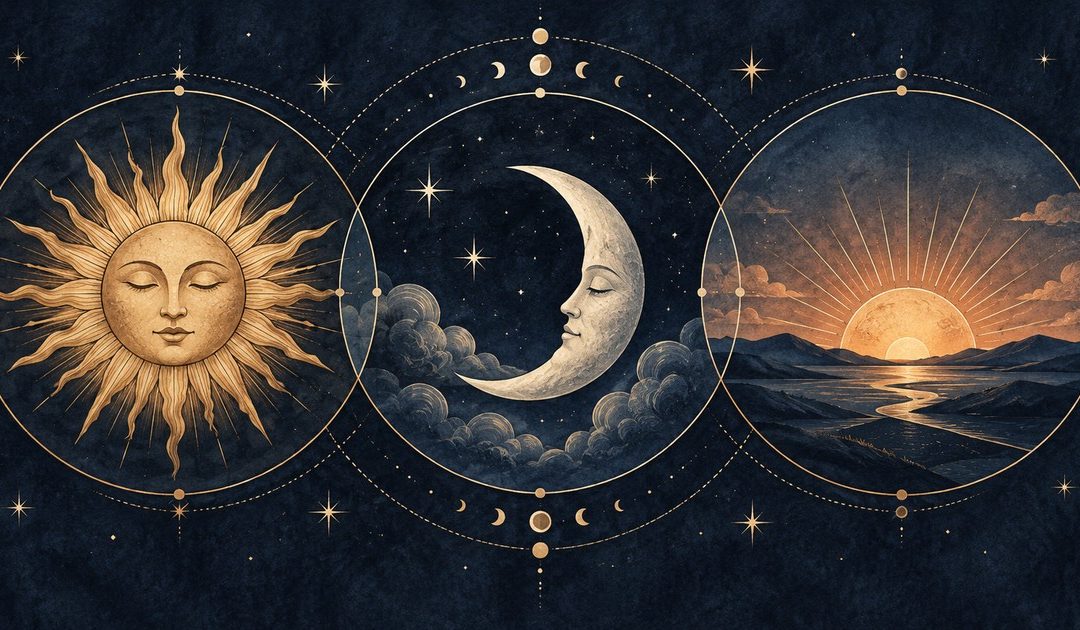
Your sun sign probably is the first part of astrology that you learned, but a birth chart has more than just one placement. The moon and rising sign give two other starting points that astrologers often use to talk about emotional patterns and the way that someone meets the world around them.
Learning birth chart basics doesn’t mean that you have to memorize every symbol on the chart wheel. Start by understanding what each of the three placements means in astrology, how they are calculated, and what it can’t tell you by itself. This is the foundation that makes the details easier to follow later.
Astrology is a symbolic language for those who like spiritual reflection. The interpretations aren’t psychological diagnoses or guarantees about personality and future events. You can look at a chart with interest while keeping your lived experiences and your choices at the center of your life.
What is in a Birth Chart?
A birth chart is also called a natal chart, and it’s a diagram that shows the positions of celestial bodies for a certain time and place. Astrologers look at the diagram and interpret it using the system they choose. The astronomical calculation and the symbolic interpretation are part of the process, but they aren’t the same kind of system.
The Sun and Moon are physical bodies. The Ascendant is a calculated point: the intersection of the ecliptic with the eastern horizon at a particular time and place. Its zodiac sign is called the rising sign; it is not another planet.
The chart normally shows other planets, houses, and aspects. Houses divide the chart into areas that can be used for interpretation, and aspects talk about angular relationships between the placements. You don’t have to learn all of these at once to start understanding the Sun, Moon, and Ascendant sign.
The first three placements can be seen as three opening questions, not as three different boxes that fully define your personality. They might give themes to think about, but the rest of the chart and certain astrological traditions affect how astrologers interpret them.
| Placement | What it is | Common symbolic theme |
|---|---|---|
| Sun | A star’s position in the zodiac | Identity and direction |
| Moon | Earth’s natural satellite’s position | Emotions and familiar needs |
| Ascendant | The rising point of the ecliptic on the eastern horizon | Approach and presentation |
The Sun and the Symbol of Direction
In some Western traditions, the Sun is associated with identity, vitality, and a sense of purpose. It can be a way to look at what you want to express or develop. This is what people mean when they ask for someone’s star sign.
The Astrodienst’s explanation of the Sun describes its role within astrological interpretation. That source explains a tradition’s symbolism; it does not establish that a solar placement determines a person’s behavior. The distinction leaves room for interpretation without turning a sign into a verdict.
You can do this to help you. Ask yourself when you feel most energized while doing something. You might see that the answer is organizing, learning, caring for others, taking initiative, or creating something. Compare these examples with the themes in the Sun sign description instead of thinking that the description has to fit every part of your life.
If you read something about the Sun sign, and it doesn’t sound like you, you don’t have to invent your own hidden personality to make this work. You might decide another interpretive approach works and find the language too broad, or you might just disagree. Your own account of your own life is still important.
The Moon and Your Emotional Needs
In modern astrology, the Moon is often connected with your emotions, familiar habits, and the things that help you feel comfortable and secure. Looking at your Moon sign can be one way to think about how you respond when you’re tired, stressed, upset, or just needing that feeling of being at home.
Your Moon sign can’t diagnose your attachment style, mental health, or explain everything about your family history. Those parts of your life are much more complicated than one placement in a birth chart. It’s also important not to use someone’s Moon sign to assume what their childhood was like or tell them that they must have certain emotional problems.
Instead, you can use your Moon sign as a way to think about what helps you feel more emotionally steady. You might ask yourself, “What helps me feel calm enough to think clearly about what I’m feeling?” Maybe you need some quiet time, a plan, someone to talk to, some movement, or simply enough time to figure out what you’re feeling. Paying attention to what really works for you can be helpful, even when it doesn’t perfectly match what astrology says about your Moon sign.
Dreams can also be part of this kind of personal reflection, especially if you connect the Moon with intuition. A vivid dream might bring up a feeling or situation that you want to think about more. However, a dream doesn’t prove that your Moon placement caused something to happen, and it can’t tell you for certain what another person is thinking or feeling.
Rising Sign and the World Around You
The Rising sign is often talked about in terms of how you go into a situation, present yourself, or start engaging with the world around you. This is called a mask by some, but this can be misleading. Some interpretations say that it’s a broader orientation instead of a false identity that’s hiding the real one.
The Astrodienst’s Ascendant reference explains the horizon point and its astrological role. Because it depends on the rotation of the Earth and the observer’s location, birth time matters greatly to its calculation. A guessed time can produce an impressive-looking chart with an unreliable Ascendant.
When you reflect, think about how you look at unfamiliar settings. Do you first observe and then start a conversation, or do you look for instructions before you start doing something practical? These are patterns you can pay attention to, not behaviors that a rising sign requires you to do.
People can act differently in different environments. Someone might be relaxed with close friends and be completely different at their job. Culture, safety, experience, and disability in ordinary circumstances shape the way you present yourself. A chart can’t erase this kind of context.
For more on avoiding fixed labels, see why zodiac symbolism is not a physical test. Our guide to zodiac signs and relationship trust also keeps real behavior at the center.
Reading the Three Placements Together
Your Sun, Moon, and rising signs might seem like they describe completely different sides of you, and that’s okay. People can want more than one thing at the same time. You might want independence but also crave closeness or enjoy adventure while still needing stability. You don’t need astrology to explain why you can have different needs or sides of your personality.
Consider a hypothetical person with an Aries Sun, Cancer Moon, and Libra rising. A modern astrologer might connect the Aries Sun with taking initiative, the Cancer Moon with emotional comfort and security, and the Libra rising with wanting harmony when dealing with other people. These are possible themes to explore, though, not guaranteed personality traits or predictions about how everyone with these placements will behave.
Instead of trying to turn each placement into a fixed personality trait, you can use them to come up with questions that actually help you reflect. You might ask, “How can I start something that matters to me while still making room for comfort and cooperation?” This gives you something you can think about and try in your everyday life without assuming that your birth chart has already decided how you’ll respond.
If you’re thinking about taking a new class, you could sign up for it, plan something familiar and relaxing afterward, and even ask a friend to join you. Doing those things doesn’t prove that your birth chart is responsible for your decisions. It simply shows how you can take an astrological idea and turn it into something practical that might work for you.
Don’t Treat One Placement as the “Real You”
You might hear that your Sun sign represents who you really are, your Moon sign is your hidden or private self, and your rising sign is how everyone else sees you. It’s an easy way to explain the three placements, but it can make both astrology and personality seem much simpler than they really are.
Different astrology traditions don’t always give the same importance to each placement, and even modern Western astrologers can interpret them differently. A reader might also look at things like the relationships between planets, the chart ruler, and the houses before deciding which themes seem most important. That’s why a short description on social media can’t really represent everything that might be considered in a full birth chart.
You also don’t have to decide that one part of your chart represents your most authentic self. Your values, decisions, relationships, experiences, and changing circumstances can all shape the way you understand yourself. Astrology can give you ideas to reflect on, but it should still leave room for you to change, grow, and make your own decisions.
If part of an astrology description feels useful, focus on what you can actually do with it. For example, realizing, “I need more time before I answer difficult questions,” gives you something practical to work with. Saying, “My Moon sign makes it impossible for me to communicate,” can make something feel fixed when there might actually be ways to improve it.
Using Accurate Information
To calculate a natal chart, enter the birth date, local birth time and birthplace. You should use the original local time that’s recorded and let a reputable calculator work with the time zone conversions. Don’t adjust the exact times yourself unless you have a tool that asks you to do so.
The Astrodienst’s birth-time guidance explains why time accuracy and historical time-zone information matter. A rounded family recollection and a documented time are not equally precise, even if both are offered in good faith. Keep a note of where the information came from. If you do not know the time, mark it as unknown. A noon placeholder can show approximate planetary positions, but it does not establish your rising sign or house placements. The Moon might change signs during the day, and the Sun can also be different near the ingress, when the Sun moves into a new sign.
An unknown birth time doesn’t mean that every kind of astrological interpretation is over for you. It means separating placements that remain stable across the possible times from those that cannot be established confidently. Writing down uncertainty can be more useful than selecting a time just because the description sounds interesting or familiar to you.
Zodiac and House Settings
Two websites can have different-looking charts because they use different settings. Tropical and sidereal zodiacs use different reference frameworks. A difference in sign placement between them doesn’t mean that one site entered your birthday incorrectly.
House systems can also change how the areas of the chart are divided. Some of the placements might move from one house to another when the system changes, even if the underlying planetary positions stay the same. Always ask which system the reader uses before you compare the different interpretations.
You don’t have to decide which approach is the best before you learn a new interpretation. Picking one clearly identified system for your study so that explanations are consistent can work for you. If you decide later to look at something else, keep the differences separate instead of trying to combine labels that don’t work together without explaining why.
Avoid the idea that one surprising chart has to be correct for your identity. Check the details, such as the date, format, morning or evening, time zone, settings, and location. Technical errors can happen even when using spiritual tools.
Take Time to Reflect
After you read a description, write one example that fits and one that doesn’t. This helps prevent broad statements from taking in every possible experience you’ve had. You aren’t trying to stop the interpretation, but you’re giving it a fair place in your actual life.
Pick one question you can look at without having to use the chart.
- Sun: What work or activity feels meaningful to me?
- Moon: What helps me rest and feel emotionally steady?
- Ascendant: How do I approach unfamiliar situations?
Keep experiments small and reversible. You can try different morning routines or write down a clear response before you go to a meeting. Don’t use a placement alone to pick medical treatment, understand your finances, leave a relationship, or decide that another person isn’t able to be trusted.
If you like talking about charts with friends, ask permission before you interpret theirs. Someone’s birth information and private history belong to them. They might be interested in having this conversation about symbolism, but then decline the claims about relationships, trauma, or destiny, and that’s their choice.
Learning Symbols in Order
A chart wheel can look crowded because it shows different layers all at once. Start by finding the labels for the Sun, Moon, and Ascendant in the accompanying list or legend. Write the sign names in regular words before you try to memorize the glyphs. You can learn the visual language slowly.
Next, pay attention to the sign and the degree. A placement that shows a particular degree in a sign isn’t an additional sign or a ranking of how strong it is. The degree records the position. What an astrologer does with that position is a different thing and part of the interpretation.
You may also see the Sun and Moon grouped with planets in an astrology program. This is conventional astrological language; astronomically, the Sun is a star, and the Moon is Earth’s natural satellite. The rising sign is neither. Keeping those categories straight makes descriptions less confusing.
If a report uses unfamiliar shorthand, consult its legend rather than assuming every symbol has a personal message. Technical notation is often simply a compact way to display information. Learning these things can make you less dependent on dramatic explanations from a reader.
For your first session of study, once you can identify the three placements and explain the difference between them, stop. Just take small amounts of time to understand things better, and this is more useful than getting a bunch of interpretations that you don’t understand.
Final Thoughts: Let the Chart Ask Questions
Birth charts are easier to understand when you keep calculations, traditions, and personal meaning separate. The chart records the positions using a certain setting. Astrology assigns the symbolic meaning to these positions, and then you get to decide what interpretation gives you something useful that you can reflect on.
The sun, moon, and rising sign can give you a manageable start for reflecting on identity, emotional needs and your approach to unfamiliar situations. They don’t need to explain everything, and they don’t have to remove your chances to change.
Start with the right information when you can and leave the uncertain details uncertain while you keep the language movable. Understanding astrology can include curiosity, intuition, and the freedom to say that a certain description doesn’t fit.