

Reading context: These are possible patterns for reflection, not a diagnosis or a universal explanation for becoming attached. People vary; if distress persists, consider appropriate professional support.
One of the most draining experiences in dating is getting attached to someone too soon. This happens often when the connection feels intense, exciting, or promising right at the beginning.
At first, this might feel harmless: you go on some good dates, the chemistry feels strong, and the conversation is easy. You might start thinking that you found something real, and before you even realize it, your emotional world starts revolving around someone you barely know. You might even start:
- Imagining a future with them.
- Depending on their texts, to get you going.
- Replying to full conversations constantly.
- Always checking your phone to see if they’ve messaged.
- Getting anxious over small behavior changes.
- Feeling stressed when communication slows down.
- Spiraling over uncertainty.
Strong attraction may coexist with worry and hopes for the future. If dating begins to crowd out other parts of your life, consider its effect on:
- Balance.
- Confidence.
- Self-worth.
- Objectivity.
- Judgment about relationships.
Once the attachment becomes stronger than your reality, you stop seeing the person you’re dating clearly.
What Does Getting Attached Too Soon Mean?
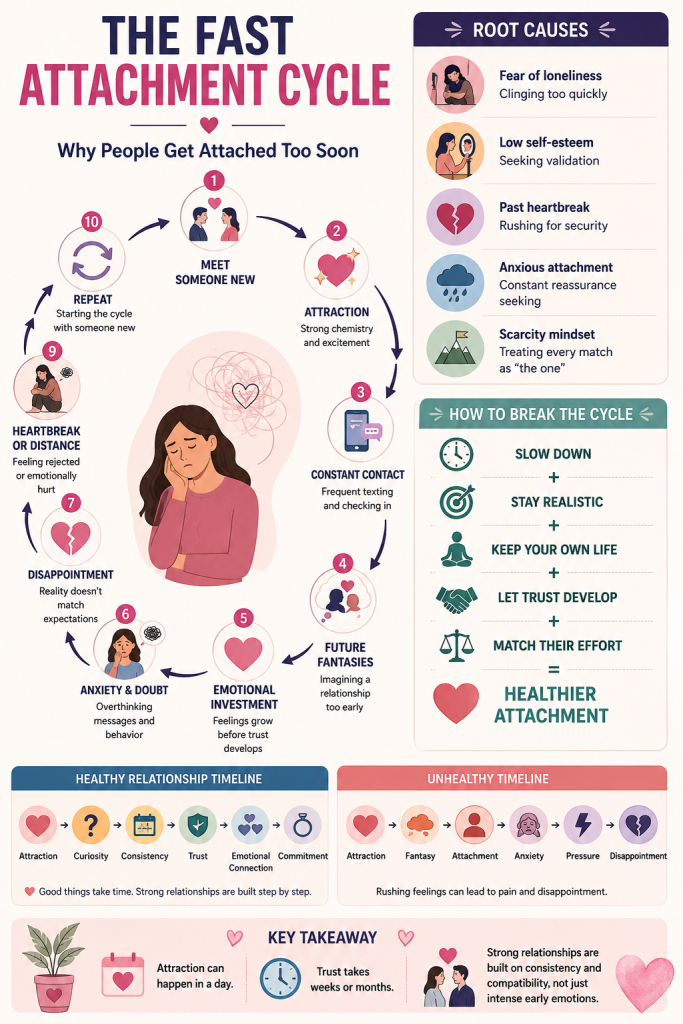
Getting attached too soon doesn’t just mean that you like someone a lot. It means that you’re investing in a future version of the relationship before enough information is there to see what kind of attachment you have. This means that your emotional investment becomes larger than the relationship itself. The kind of relationship you have right now, you only know things like:
- Attraction.
- Surface-level chemistry.
- Limited experiences together.
- Few conversations.
But emotionally, you are already imagining things like future plans, security, long-term commitment, and soulmate potential. This can create an attachment to possibility instead of reality. Once fantasies start entering your dating life, it is hard to have clarity in the relationship.
When Early Dating Takes Up Your Attention
If you spend more time checking messages than enjoying the connection, notice what is happening without labelling yourself addicted. Ask directly about communication preferences, put your phone aside during other activities, and consider whether this arrangement meets your needs.
Why People Get Attached Too Soon
People become attached at different speeds for different reasons. The following prompts can help you reflect on your experience without assuming a single cause.
1. You May Want More Certainty
A promising connection can bring both excitement and unanswered questions. Notice whether you are getting to know the person or mainly seeking reassurance about the future. Wanting clarity is understandable; it does not establish an attachment style or diagnosis.
2. Sometimes You’re Falling for Potential Instead of Reality
A lot of people don’t actually fall for who someone truly is in the beginning, but instead they fall for things like:
- Imagined future connection.
- Emotional fantasy.
- Projected compatibility.
- Who they hope the person becomes.
This often happens after only a few emotionally exciting interactions. The mind will start filling in missing information with positive assumptions, and you might start unconsciously projecting things like these onto someone you don’t know fully yet:
- Emotional depth.
- Consistency.
- Emotional availability.
- Long-term compatibility.
- Future commitment.
As time goes on, fantasy-driven attachment can cloud emotional judgment because you start bonding more with imagination instead of observable reality.
3. Intensity Does Not Establish Compatibility
Strong feelings can include excitement, attraction and worry. Their intensity does not tell you whether your goals match or whether someone respects your boundaries. Enjoy the curiosity while watching how you treat each other across ordinary situations.
4. Sometimes Attachment Becomes a Way to Escape Uncertainty
Uncertainty feels emotionally uncomfortable for a lot of people. Instead of dealing with the discomfort, they sometimes say, “I don’t know where this is going yet,” and the mind can fast-forward to attachment because this fantasy creates a temporary certainty.
In other words, attachment can become an emotional coping mechanism where fantasy can relieve uncertainty temporarily, but it can also create dependency.
Healthy dating usually requires learning how to emotionally tolerate uncertainty long enough to evaluate compatibility clearly.
5. Relationships Sometimes Become Tied to Self-Worth
Sometimes, over-attachment happens because the relationship starts becoming emotionally connected to self-worth. Their attention emotionally starts to mean:
- “I’m lovable.”
- “I matter.”
- “I’m enough.”
- “I’m desirable.”
As a result:
- Distance feels emotionally devastating.
- Attention feels emotionally euphoric.
This creates emotional dependency on external validation. And unfortunately, relationships built mainly on validation-seeking often become emotionally unstable quickly.
6. Fear of Missing Out Can Intensify Attachment
A lot of people unconsciously attach too quickly because they fear:
- Losing the opportunity.
- Being alone.
- Starting over emotionally.
- Not finding another connection.
- Emotional abandonment.
Scarcity thinking usually intensifies attachment dramatically, and instead of evaluating compatibility, fear causes there to be an emotional investment too soon.
7. Inconsistent Contact Can Leave You Guessing
Repeatedly cancelled plans or unclear replies can leave you wanting an explanation. You do not have to diagnose someone or win more attention. Describe the pattern, ask what they can realistically offer, and decide whether that works for you.
8. There Are Usually Signs You’re Becoming Attached Too Quickly
You might be emotionally over-attaching if:
- You check your phone constantly.
- Your mood heavily depends on their responses.
- You imagine commitment immediately.
- Inconsistency feels emotionally devastating.
- You emotionally prioritize them too quickly.
- You ignore red flags because of chemistry.
- You over-give emotionally early on.
- You constantly seek reassurance.
- Your anxiety increases more than emotional security.
These are reflection prompts, not diagnostic signs. Consider whether your choices fit what you actually know and whether the relationship leaves room for the rest of your life.
9. Over-Attachment Usually Creates Emotional Suffering
Premature attachment often distorts emotional perception. When emotionally attached too quickly, people often:
- Ignore incompatibilities.
- Rationalize poor behavior.
- Tolerate inconsistency.
- Abandon boundaries.
- Emotionally over-function.
- Prioritize fantasy over reality.
Keep asking, “Is this relationship healthy for me?” If your main concern becomes “How do I keep this from disappearing?”, pause to consider respect, reciprocity and compatibility before making a bigger commitment.
10. Stay Grounded in What’s Actually Happening
One of the healthiest dating habits is staying emotionally connected to observable reality instead of imagined outcomes.
After spending time with someone, it helps to ask things like, “What did I genuinely learn about this person today?” instead of asking, “Could this become my future relationship?”
Staying grounded emotionally helps prevent fantasy from accelerating attachment too quickly.
11. Don’t Fill in Emotional Gaps Automatically
If someone hasn’t clearly shown these things, then don’t assume these qualities are there yet:
- Consistency.
- Reliability.
- Emotional availability.
- Effort.
Allow behavior as time goes on to show character naturally instead of emotionally filling in the blanks yourself.
12. Fantasy Thinking Often Accelerates Attachment
When you notice yourself imagining these things, then you need to emotionally pause and reconnect with what’s happening in the present.
- Vacations together.
- Future commitment.
- Emotional certainty.
- Long-term fantasy scenarios.
Fantasy usually accelerates attachment much faster than reality does.
13. Keep Your Own Life Emotionally Full
Healthy dating should complement your life instead of becoming your entire emotional center immediately. It’s important to maintain things like:
- Friendships.
- Goals.
- Routines.
- Hobbies.
- Emotional independence.
As time goes on, maintaining emotional balance outside of dating usually creates healthier attachment patterns, too.
14. Regulate Anxiety Before Reacting
When you feel the urge to do these things:
- Double text.
- Seek reassurance immediately.
- Emotionally chase.
- Over-explain.
Take time to pause, not to play a game but to regulate your emotions. A pause may help you choose a response that fits your needs instead of reacting immediately.
15. Watch Patterns Instead of Potential
Anyone can create chemistry temporarily. What matters more long-term are patterns like:
- Consistency.
- Communication.
- Reliability.
- Emotional maturity.
- Follow-through.
Patterns usually show emotional truth much more clearly than potential does.
16. Chemistry and Compatibility Aren’t the Same Thing
Chemistry alone doesn’t determine:
- Emotional health.
- Long-term compatibility.
- Emotional availability.
- Communication skills.
Attraction matters, but compatibility matters more in the long-term.
17. Ask Better Questions While Dating
Instead of constantly asking, “Do they like me?” healthier questions can be:
- “Do I feel emotionally safe around them?”
- “Are they emotionally available?”
- “Can I be authentic around them?”
- “Do our values align?”
- “Are they consistent?”
This changes dating from validation-seeking into emotional evaluation instead.
18. Emotional Uncertainty Is Part of Healthy Dating
Some uncertainty is ordinary while getting to know someone. You can still ask for clarity and set a limit on arrangements that leave you distressed. Being comfortable with uncertainty is not a requirement to accept inconsistency.
19. Internal Validation Changes Dating Patterns
The stronger self-worth becomes internally, the less likely someone is to emotionally depend on external validation. Internal validation sounds more like:
- “I know my value.”
- “I deserve consistency.”
- “Someone’s inconsistency doesn’t define my worth.”
These reminders can be a useful starting point. They do not guarantee a change in feelings or replace support when distress interferes with daily life.
Healthy Early Dating
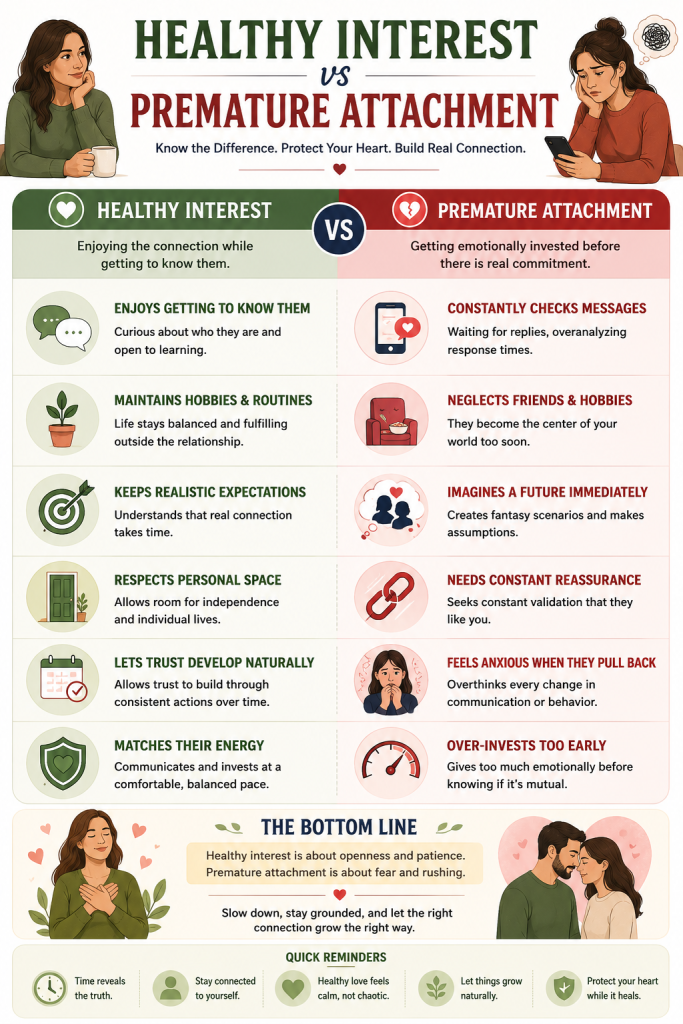
Healthy early dating can feel curious, balanced, exciting, grounded, and enjoyable. You can enjoy being connected without losing who you are.
You can still feel attraction while you look at things like:
- Shared values.
- Consistency.
- Safety.
- Compatibility.
Having a healthy connection means emotionally engaging without it taking over your identity.
Final Thoughts: Getting Attached Too Soon
Getting attached to your partner too soon doesn’t mean you have a character flaw, but it’s part of your emotional patterns. Emotional patterns can change throughout life. The goal isn’t becoming emotionally detached or acting like you don’t care about your partner, but learning to stay grounded, know your worth, regulate anxiety, and to look at the relationship clearly without abandoning who you are.
Healthy love should never require obsession for it to feel meaningful, and real intimacy gets stronger when you stay connected to who you are while getting to know someone else.
Frequently Asked Questions
1. Why do I get attached too soon?
You may get attached too soon because early attraction can feel exciting, comforting, and emotionally intense. Sometimes this happens when you are craving connection, reassurance, or proof that someone finally likes you back.
2. Is getting attached quickly always unhealthy?
No. Strong feelings alone do not make a connection unhealthy. Pay attention to mutual respect, consent, your routines, and whether your commitments fit what you know about each other.
3. What is the difference between attraction and attachment?
Attraction is interest in someone; attachment describes an emotional bond. Neither feeling by itself establishes compatibility or a mutual commitment.
4. Why do I imagine a future with someone so quickly?
You may be filling in emotional gaps with hope, fantasy, or unmet needs. When someone feels promising, the mind can rush ahead before you truly know whether the connection is stable.
5. How do I know if I am attached too fast?
Signs include constantly checking your phone, overthinking small changes, needing reassurance, ignoring red flags, and feeling emotionally dependent before the relationship is clearly defined.
6. Can anxiety make me attach faster?
For some people, worry about uncertainty brings an urge for reassurance. It is one possible experience, not an explanation an article can establish for you.
7. Why do I feel anxious when they do not text back?
A delayed reply may leave you worried, but it does not reveal the other person’s intentions. Consider the overall pattern and discuss communication expectations directly.
8. How can I stop overthinking early dating?
Focus on facts instead of assumptions. Notice what the person consistently does over time, keep your normal routines, and avoid treating every message as a sign of the relationship’s future.
9. Why do I ignore red flags when I like someone?
Strong early feelings can make you focus on potential instead of reality. If you want the connection to work badly enough, you may minimize behavior that deserves more attention.
10. How do I slow down emotionally?
Slow down by keeping your routines, spending time with friends, limiting fantasy thinking, and allowing the person to show consistency before you give them deeper emotional access.
11. Should I text less if I get attached too soon?
You do not need to play games, but it can help to avoid constant texting before trust is built. Healthy pacing gives both people room to stay grounded.
12. How long should it take to feel attached?
There is no exact timeline, but healthy attachment usually grows through repeated consistency, emotional safety, shared experiences, and mutual effort over time.
13. Can past heartbreak cause fast attachment?
Past experiences may influence what you hope for or worry about in a new connection. People respond differently; heartbreak does not necessarily cause fast attachment.
14. What role does self-esteem play in fast attachment?
Consider whether another person’s attention has become your main measure of worth. Becoming attached quickly does not by itself mean you have low self-esteem.
15. How do I stop needing reassurance so much?
Identify what you need to know, ask clearly, and observe whether the answer matches subsequent actions. Support from friends or a qualified professional may help if worry keeps disrupting your life.
16. Is it okay to be excited about someone new?
Yes. Excitement is healthy when it stays balanced. The goal is not to become emotionally cold, but to stay realistic while the connection develops.
17. How can I tell if someone is worth emotional investment?
Look for consistency, honesty, respect, emotional availability, and effort. Someone is worth deeper investment when their actions match their words over time.
18. What should I do when I feel myself becoming too attached?
Pause and check the facts. Ask yourself what you truly know about the person, whether their effort is mutual, and whether you are still caring for your own life.
19. Can healthy boundaries help prevent fast attachment?
Boundaries can protect your time and help you pace commitments. They do not control how quickly feelings develop or guarantee a particular outcome.
20. What is the healthiest way to build attachment?
Build trust through mutual respect, honest communication, shared experiences and consistent actions. There is no universal schedule; both people should have room to choose their pace.