
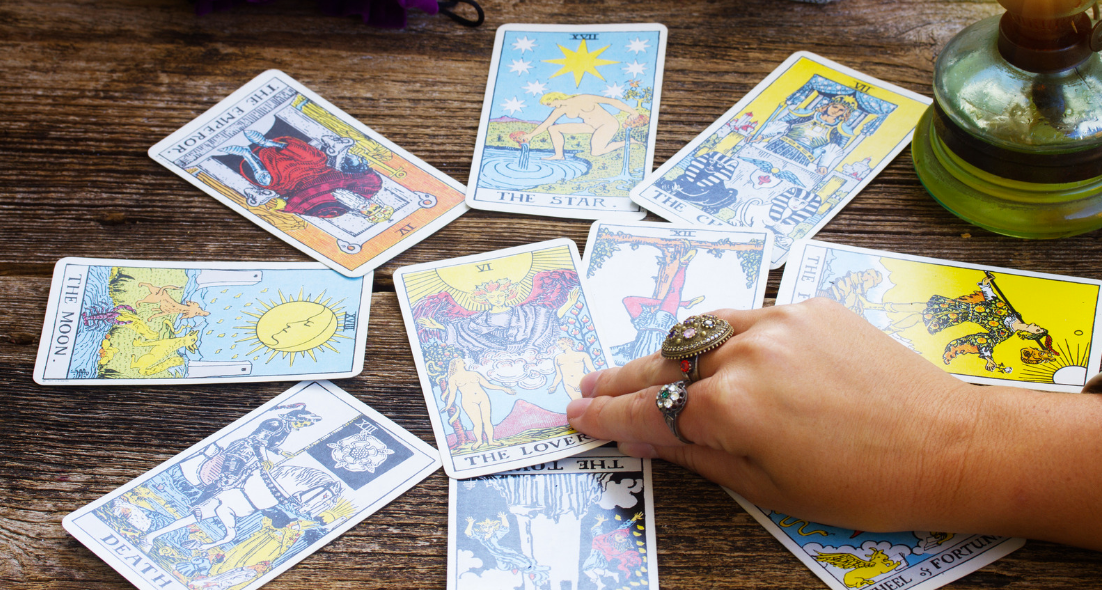
A tarot spread assigns a meaning to each card position. For a first reading, use one card or a three-card layout: situation, options, and next step. Decide what each position means before drawing, then use the images to explore your choices.
Tarot can be a spiritual practice or a reflective activity. This guide does not treat cards as proof of future events, a way to read another person’s mind, or a substitute for professional advice.
Start with the deck you have
A standard modern tarot deck contains 78 cards: 22 Major Arcana and 56 Minor Arcana. The Minor Arcana are usually grouped into four suits, often called Wands, Cups, Swords, and Pentacles. Names and artwork vary, so keep your deck’s guide nearby.
Tarot’s documented history reaches fifteenth-century Italy, where the cards were used for games. Its later fortune-telling associations should not be confused with its origins. See the Metropolitan Museum of Art’s history of tarot.
You do not need to memorize every interpretation before beginning. Notice a card’s people, objects, colours, and action. Compare that observation with the guidebook, then decide whether it suggests a useful question. Different decks do not necessarily carry identical meanings.
A one-card reading for your first practice
- Write one question, such as “What deserves my attention today?”
- Shuffle in a comfortable way and draw one card.
- Describe what you actually see before looking up its meaning.
- Write one possible connection to your question.
- Choose one small action you can take, independently of whether you accept the interpretation.
For example, an image of someone resting might prompt you to check your schedule. It does not establish that you are ill or predict that a plan will fail. The useful outcome is the practical question you examine.
A simple three-card spread: situation, options, next step
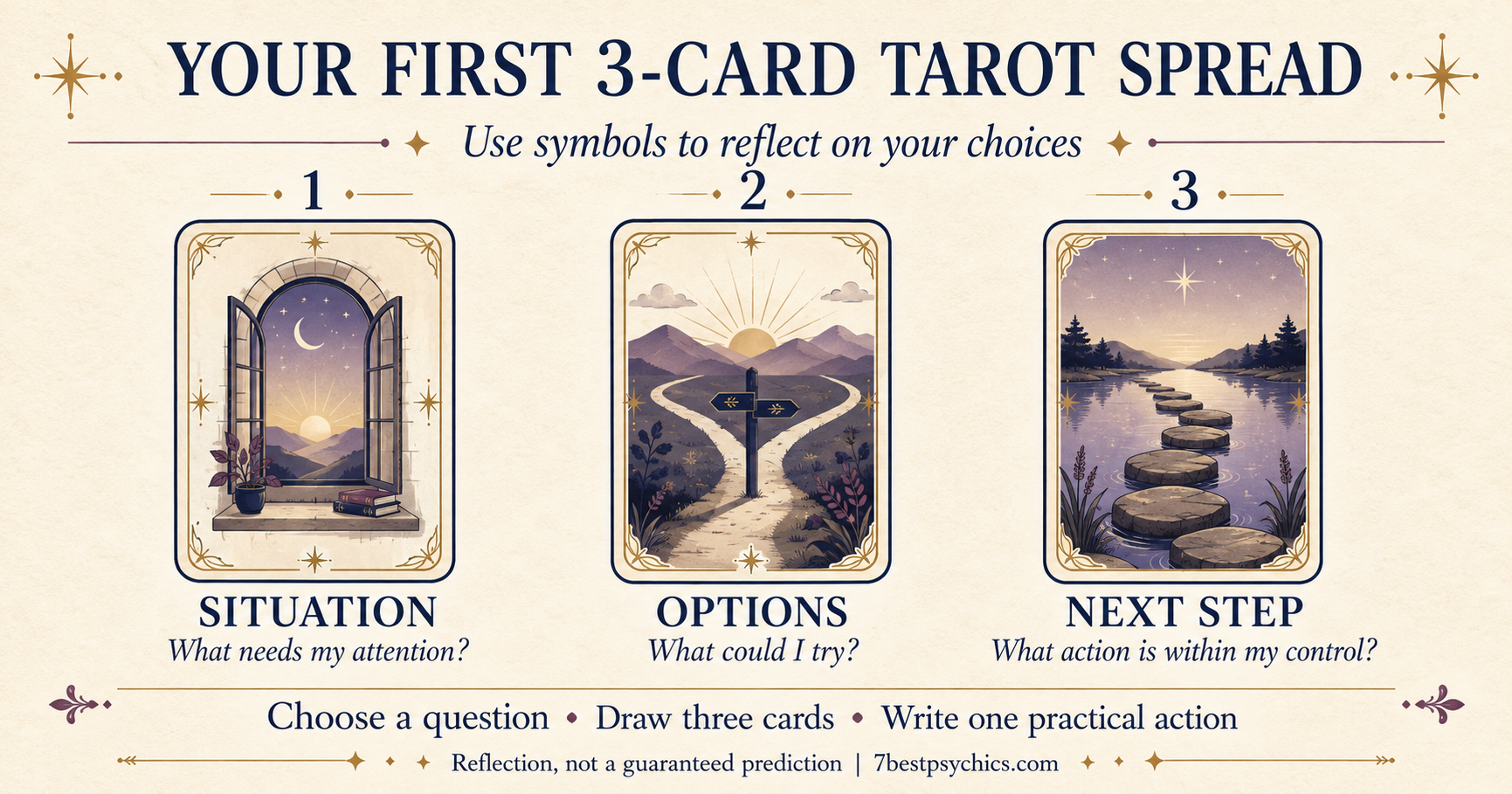
- Situation: What needs my attention? Separate known facts from assumptions.
- Options: What could I try? Write at least two possibilities rather than treating the card as a command.
- Next step: What action is within my control? Make it specific and realistic.
Lay the cards left to right. Read each one in its assigned position, then look for connections. Keep the original question visible so a striking image does not pull you into an unrelated concern.
Worked example: preparing for a difficult conversation
Suppose your question is “How can I prepare to discuss household responsibilities?” For the situation, write the facts: two chores have repeatedly gone unfinished. For options, consider a shared list or a conversation about time constraints. For the next step, choose a calm time and make one concrete request. These are hypothetical reflections, not a report of a predictive reading.
A card cannot tell you that your partner is lazy, dishonest, or secretly planning to leave. Ask directly about their experience. Our guide to managing and resolving relationship conflict offers a practical way to frame that conversation.
Other three-card layouts
- Past, present, possible future: What influenced this situation, what is happening now, and what scenario might follow? The final position is a possibility, not a promise.
- Strength, obstacle, support: What resource can I use, what challenge should I acknowledge, and where could I seek help?
- Notice, release, practise: What pattern do I notice, what expectation could I reconsider, and what habit could I try?
Choose the layout that fits your question. More cards do not automatically produce a better reading.
A five-card spread for comparing options
When three positions feel comfortable, try this decision journal:
- The decision: what am I deciding?
- Option A: what benefits and costs should I investigate?
- Option B: what benefits and costs should I investigate?
- Missing information: what do I need to check?
- Next action: what can I do before committing?
Use actual prices, schedules, evidence, and advice to evaluate the options. A symbol can prompt an overlooked question; it cannot supply a missing fact. For major decisions, read our guide to evaluating prediction claims.
Common beginner mistakes
- Changing the positions after drawing: write them down first.
- Drawing repeatedly for reassurance: pause when the exercise makes you more anxious or less decisive.
- Treating a difficult card as a threat: a dramatic image is not proof of danger or a curse.
- Assuming all decks are interchangeable: use the deck’s own guide and identify the tradition you are following.
- Starting with too many cards: a common Celtic Cross uses ten position cards; a separate significator appears in some versions. Save complex layouts until you can keep the positions distinct.
Keep a record you can revisit honestly
Write the date, question, cards, position meanings, interpretation, and chosen action. Leave the original entry intact. When reviewing it, record mismatches as well as apparent matches and distinguish what you did from what you predicted.
If you want to book a reading instead, compare the costs, policies, and boundaries of the service before paying.
Frequently asked questions
1. What is the easiest tarot spread for a beginner?
Start with one card and one open-ended question. Move to three cards when assigning a separate meaning to each position feels manageable.
2. What do the three cards represent?
You choose the positions before drawing. This guide uses situation, options, and next step; other readers use past, present, and possible future.
3. How many cards are in a standard tarot deck?
A standard modern tarot deck has 78 cards: 22 Major Arcana and 56 Minor Arcana. Some specialty decks differ.
4. Do all tarot decks use identical meanings?
No. Many share a structure, but artwork, suit names, symbolism, and reading traditions can differ. Consult the guide for your deck.
5. How do I shuffle the cards?
Use any comfortable method that mixes the cards without damaging them. There is no required number of shuffles for this exercise.
6. Should I choose the question before drawing?
Yes. Write the question and position meanings first so you do not keep changing the interpretation to fit the result.
7. Can I read tarot for myself?
Yes, as a reflective activity. Keep notes and distinguish what you already know from ideas suggested by the images.
8. What is a useful relationship question?
Ask what you need to communicate or what boundary you can set. Cards cannot establish another person’s private thoughts or consent.
9. Should beginners read reversed cards?
Reversals are optional. You can begin with upright meanings and introduce a consistent reversal method later.
10. What if I do not understand a card?
Describe the image, check the deck guide, and record one tentative interpretation. It is fine to leave a question unresolved.
11. Can I keep drawing until I get a positive answer?
Repeatedly replacing an unwanted card can turn the exercise into reassurance seeking. Stop, record the result, and return to observable facts.
12. Does a future position guarantee what will happen?
No. Treat it as a possible scenario to consider, not a verified forecast or instruction.
13. Can tarot decide health or financial questions?
Use qualified professional advice and relevant evidence for those decisions. A spread is not a diagnostic or investment tool.
14. How many cards are in a Celtic Cross spread?
A common Celtic Cross layout uses ten position cards. Some versions add a separate significator card, so check the method being taught.
15. What should I write in a tarot journal?
Record the date, question, position meanings, cards, your interpretation, and one practical action. Later note what actually happened without rewriting the original entry.